
SJ/T 11989-2025 Mini Projector Specification
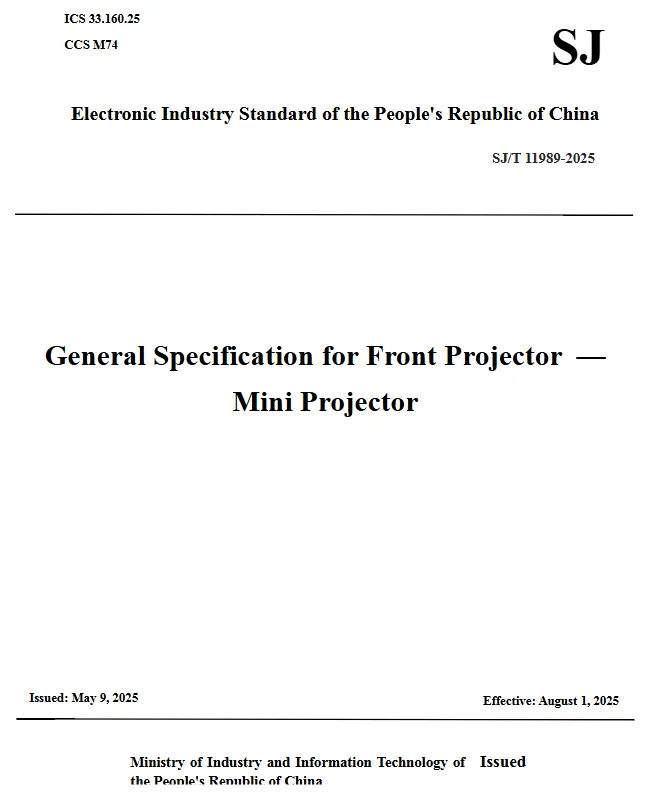
General Specification for Front Projector — Mini Projector
Standard Details
SJ/T 11989-2025 (English Version)
- English translated version
- Sent to your email in 24h
SJ/T 11989-2025 (Chinese Version)
- Chinese original version
- Sent to your email in 12h
Standard Introduction
This standard applies to mini projectors but excludes those using single-chip LCD as the display system. It defines differentiated functional requirements across the three types.
All types require remote control, upgrade function, Chinese menu, focus, overheat protection and factory reset as mandatory. Household projectors additionally require network connectivity, while commercial projectors optionally support remote management. Optional features include brightness/contrast adjustment, image modes, Bluetooth, auto-standby, voice control, multi-screen interaction, eye protection, multimedia support and online video playback.
The document also specifies detailed display performance tables with type-specific thresholds for colour gamut coverage, red light ratio and convergence error.
Standard Catalog
The standard consists of the following main sections:
1 Scope 1
2 Normative References 1
3 Terms and Definitions 1
4 Classification 2
5 Basic Requirements 2
5.1 Operating Conditions 2
5.2 Graphical Symbols 2
6 Technical Requirements 2
6.1 Appearance and Structure 2
6.2 Functions 3
6.3 Supported Signal Formats 3
6.4 Interfaces 3
6.5 Display Performance 4
6.6 Noise 5
6.7 Remote Control Reception Performance 5
6.8 Remote Control Transmission Performance 5
6.9 Projection Efficiency 6
6.10 Power Consumption 6
6.11 Electromagnetic Compatibility 6
6.11.1 Radiated and Conducted Emission 6
6.11.2 Harmonic Current Emission 6
6.11.3 Voltage Changes, Fluctuations and Flicker 6
6.11.4 Immunity 6
6.12 Safety 6
6.12.1 General Requirements 6
6.12.2 Optical Radiation Safety 6
6.13 Reliability 6
6.14 Environmental Adaptability 6
6.15 Unpacking Inspection 6
6.16 Workmanship and Assembly 6
6.17 Product Instructions 6
6.18 Environmental Protection 6
7 Test Conditions and Methods 7
7.1 Appearance and Structure 7
7.2 Functions 7
7.3 Signal Formats 7
7.4 Interfaces 7
7.5 Display Performance 7
7.6 Noise 7
7.7 Remote Control Reception Performance 7
7.8 Remote Control Transmission Performance 7
7.9 Projection Efficiency 7
7.10 Power Consumption 7
7.11 Electromagnetic Compatibility 8
7.12 Safety 8
7.12.1 General Requirements 8
7.12.2 Optical Radiation Safety 8
7.13 Reliability 9
7.14 Environmental Adaptability 9
7.15 Unpacking Inspection 9
7.16 Workmanship and Assembly 9
7.17 Product Instructions 9
7.18 Environmental Protection 9
8 Inspection Rules 9
8.1 Inspection Classification 9
8.2 Type Approval Inspection 9
8.2.1 Purpose 9
8.2.2 Inspection Items 9
8.2.3 Sampling and Sample Size 10
8.2.4 Non-Conformity Classification and Criteria 10
8.2.4.1 Non-Conformity Classification 10
8.2.4.2 Non-Conforming Product Classification 10
8.2.4.3 Non-Conformity Criteria 10
8.2.5 Acceptance and Rejection Determination 11
8.3 Acceptance Inspection 13
8.3.1 Purpose 13
8.3.2 Inspection Items 13
8.3.2.1 Unpacking Inspection 13
8.3.2.2 Workmanship and Assembly Inspection 13
8.3.2.3 Performance Inspection 13
8.3.3 Sampling Plan 14
8.3.4 Non-Conformity Classification and Criteria 14
8.3.5 Acceptance Inspection Determination 14
8.3.6 Handling of Inspection Results 14
8.4 Routine Inspection 14
8.4.1 Purpose 14
8.4.2 Inspection Period 14
8.4.3 Inspection Items 14
8.4.4 Sampling Plan 15
8.4.5 Non-Conformity Classification and Criteria 15
8.4.6 Sampling 16
8.4.7 Routine Inspection Determination 16
8.4.8 Handling of Inspection Results 16
9 Marking, Packaging, Transportation and Storage 16
9.1 Marking 16
9.2 Packaging 16
9.3 Transportation 16
9.4 Storage 16
English Version Preview
Preview coming soon. Need a sample? Contact us now.
Chinese Version Preview
Preview of the original Chinese version: