
SJ/T 11987-2025 Education and Business Projector Specification
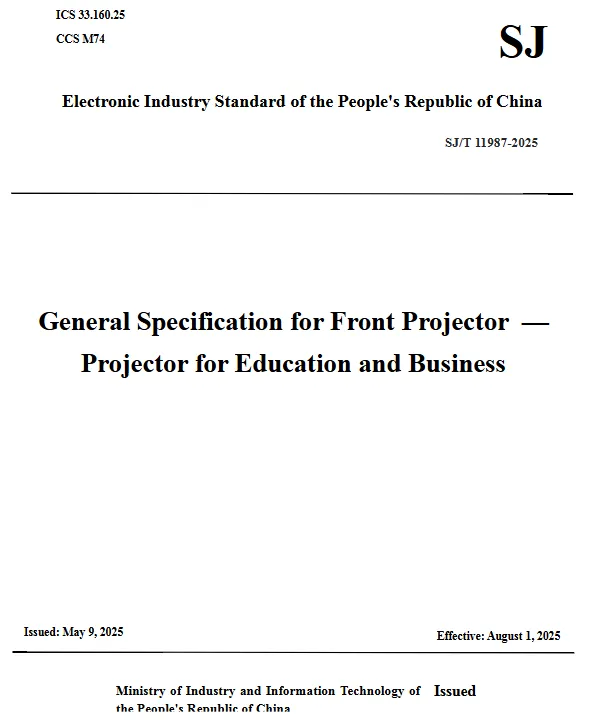
General Specification for Front Projector — Projector for Education and Business
Standard Details
SJ/T 11987-2025 (English Version)
- English translated version
- Sent to your email in 24h
SJ/T 11987-2025 (Chinese Version)
- Chinese original version
- Sent to your email in 12h
Standard Introduction
This standard applies to projectors used in teaching, training, business meetings and office environments. Display performance requirements include illuminance uniformity (>=80%), contrast (>=150:1), on-off ratio (>=500:1), colour light output ratio (>=50%), colour gamut coverage (>=24% for halogen, >=27% for solid-state light sources) and red light ratio (>=5%).
The document also specifies on-off ratio (>=500:1 for education/business vs >=1000:1 for engineering projectors per SJ/T 11986) as a key differentiator. Functional requirements distinguish between smart and feature projectors, with optional extras such as electronic whiteboard support, Bluetooth, sound output, multi-screen interaction, altitude adaptation and built-in educational software.
Standard Catalog
The standard consists of the following main sections:
1 Scope 1
2 Normative References 1
3 Terms and Definitions 1
4 Classification 2
5 Basic Requirements 2
5.1 Operating Conditions 2
5.2 Graphical Symbols 2
6 Technical Requirements 2
6.1 Appearance and Structure 2
6.2 Functions 3
6.3 Display Format 3
6.4 Interfaces 4
6.5 Display Performance 4
6.6 Noise 5
6.7 Remote Control Reception Performance 5
6.8 Remote Control Transmission Performance 5
6.9 Projection Efficiency 5
6.10 Power Consumption 5
6.11 Electromagnetic Compatibility 6
6.11.1 Radiated and Conducted Emission 6
6.11.2 Harmonic Current Emission 6
6.11.3 Voltage Changes, Fluctuations and Flicker 6
6.11.4 Immunity 6
6.12 Safety 6
6.12.1 General Requirements 6
6.12.2 Optical Radiation Safety 6
6.13 Reliability 6
6.14 Environmental Adaptability 6
6.15 Unpacking Inspection 6
6.16 Workmanship and Assembly 6
6.17 Product Instructions 6
7 Test Conditions and Methods 7
7.1 Appearance and Structure 7
7.2 Functions 7
7.3 Display Format 7
7.4 Interfaces 7
7.5 Display Performance 7
7.6 Noise 8
7.7 Remote Control Reception Performance 8
7.8 Remote Control Transmission Performance 8
7.9 Projection Efficiency 8
7.10 Power Consumption 8
7.11 Electromagnetic Compatibility 8
7.12 Safety 8
7.12.1 General Requirements 8
7.12.2 Optical Radiation Safety 8
7.13 Reliability 8
7.14 Environmental Adaptability 8
7.15 Unpacking Inspection 9
7.16 Workmanship and Assembly 9
7.17 Product Instructions 9
7.18 Environmental Protection 9
8 Inspection Rules 9
8.1 Inspection Classification 9
8.2 Type Approval Inspection 9
8.2.1 Purpose 9
8.2.2 Inspection Items 9
8.2.3 Sampling and Sample Size 10
8.2.4 Non-Conformity Classification and Criteria 10
8.2.4.1 Non-Conformity Classification 10
8.2.4.2 Non-Conforming Product Classification 10
8.2.4.3 Non-Conformity Criteria 10
8.2.5 Acceptance and Rejection Determination 11
8.3 Acceptance Inspection 12
8.3.1 Purpose 12
8.3.2 Inspection Items 12
8.3.2.1 Unpacking Inspection 12
8.3.2.2 Workmanship and Assembly Inspection 12
8.3.2.3 Performance Inspection 12
8.3.3 Sampling Plan 14
8.3.4 Non-Conformity Classification and Criteria 14
8.3.5 Acceptance Inspection Determination 15
8.3.6 Handling of Inspection Results 15
8.4 Routine Inspection 15
8.4.1 Purpose 15
8.4.2 Inspection Period 15
8.4.3 Inspection Items 15
8.4.4 Sampling Plan 16
8.4.5 Non-Conformity Classification and Criteria 16
8.4.6 Sampling 17
8.4.7 Routine Inspection Determination 17
8.4.8 Handling of Inspection Results 17
9 Marking, Packaging, Transportation and Storage 17
9.1 Marking 17
9.2 Packaging 17
9.3 Transportation 17
9.4 Storage 17
Appendix A (Normative) Unpacking Inspection Contents and Non-Conformity Criteria 18
Appendix B (Normative) Workmanship and Assembly Inspection Contents and Non-Conformity Criteria 21
Appendix C (Normative) Technical Elements in Product Instructions 22
Appendix D (Normative) Environmental Adaptability Contents and Non-Conformity Criteria 23
English Version Preview
Preview coming soon. Need a sample? Contact us now.
Chinese Version Preview
Preview of the original Chinese version: