
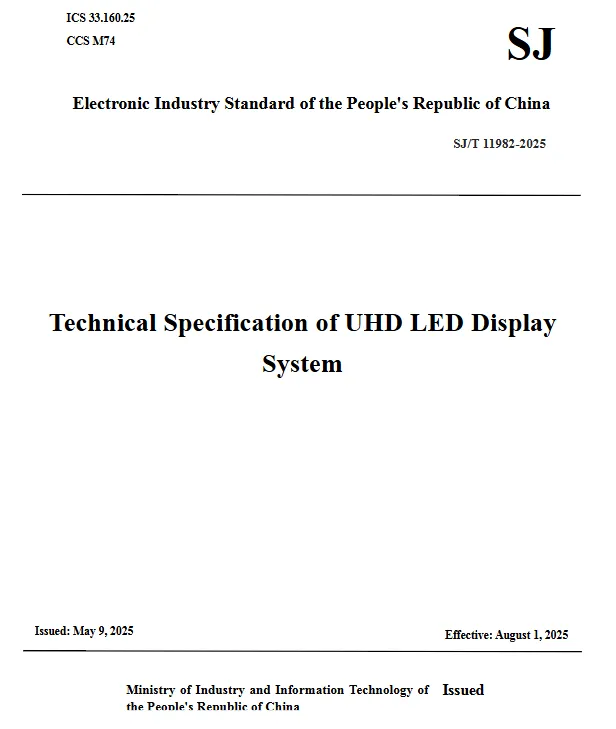
SJ/T 11982-2025 UHD LED Display System Specification
Technical Specification of Ultra-High Definition Light Emitting Diode (LED) Display System
Standard Details
SJ/T 11982-2025 (English Version)
- English translated version
- Sent to your email in 24h
SJ/T 11982-2025 (Chinese Version)
- Chinese original version
- Sent to your email in 12h
Standard Introduction
This standard applies to 4K (3840x2160 and above) and 8K (7680x4320 and above) LED display systems used in both indoor and outdoor scenarios.
It differentiates indoor and outdoor performance thresholds for parameters such as maximum luminance (600 cd/m2 indoor, 4000 cd/m2 outdoor), contrast ratio, viewing angle and pixel defect rate.
The document also specifies protection rating requirements for outdoor installations (front IP65, rear IP43), energy efficiency compliance for fine-pitch displays, and detailed test procedures including dark-room measurement conditions, test signal patterns and instrument requirements.
Standard Catalog
The standard consists of the following main sections:
1 Scope 1
2 Normative References 1
3 Terms and Definitions 1
4 Abbreviations 2
5 Basic Requirements 3
5.1 Normal Operating Conditions 3
5.2 Appearance and Structure 3
5.3 Functional Requirements 3
5.4 System Interfaces 4
5.5 Image Formats 4
5.6 Physical Performance 5
5.7 Display Performance 5
5.8 Protection Rating 6
5.9 Safety 6
5.10 Electromagnetic Compatibility 6
5.11 Environmental Adaptability 6
5.12 Reliability 6
5.13 Energy Efficiency 6
6 Test Conditions 6
6.1 Environmental Conditions 6
6.2 Test Preparation 7
6.3 Test Instruments 7
6.3.1 Signal Generator 7
6.3.2 Spectroradiometer 7
6.3.3 Illuminance Meter 7
6.3.4 Oscilloscope 7
6.3.5 Vernier Caliper 7
6.3.6 Angle Ruler 7
6.3.7 Feeler Gauge 7
6.3.8 Photoelectric Sensor 7
6.3.9 High-Speed Camera 7
6.3.10 AC Regulated Power Supply 7
6.4 Test Signals 8
6.4.1 Overview 8
6.4.2 Colour Bar Signal 8
6.4.3 Full White and Full Black Field Signals 9
6.4.4 Full Red, Full Green and Full Blue Field Signals 9
6.4.5 Chromaticity Viewing Angle Test Signal 10
6.4.6 Single Pixel Signal 10
6.5 Test Sample and Test Area 10
7 Test Methods 11
7.1 Appearance and Structure 11
7.2 Functional Check 11
7.2.1 Video Input 11
7.2.2 Brightness Adjustment 11
7.2.3 Colour Adjustment 11
7.2.4 Colour Temperature Adjustment 11
7.2.5 Signal Windowing 11
7.2.6 Signal Switching 11
7.2.7 HDR Support 12
7.2.8 Full-Screen Display 12
7.2.9 Full-Screen Roaming 12
7.2.10 Window Scaling 12
7.2.11 Window Overlay 12
7.2.12 Brightness Correction 12
7.2.13 Chromaticity Correction 12
7.2.14 Signal Preview and Playback 12
7.2.15 Scene Setting and Patrol 13
7.2.16 Built-in Background Image 13
7.2.17 Signal Redundancy Backup 13
7.2.18 System Visual Management 13
7.2.19 System Visual O&M 13
7.2.20 3D Display 13
7.3 Interface Check 13
7.4 Image Format Test 14
7.4.1 Test Signal 14
7.4.2 Test Procedure 14
7.5 Physical Performance Test 14
7.5.1 Flatness 14
7.5.2 Pixel Centre Pitch Relative Deviation 14
7.5.3 Horizontal Misalignment 14
7.5.4 Vertical Misalignment 14
7.6 Display Performance Test 15
7.6.1 Physical Resolution 15
7.6.2 Maximum Luminance 15
7.6.3 Viewing Angle 16
7.6.4 Chromaticity Viewing Angle 16
7.6.5 Contrast Ratio 16
7.6.6 Luminance Uniformity 16
7.6.7 Chromaticity Non-Uniformity 17
7.6.8 Colour Gamut Coverage (BT.2020) 17
7.6.9 Frame Rate 18
7.6.10 Refresh Rate 18
7.6.11 Signal Processing Bits 18
7.6.12 Supported Signal Input 18
7.6.13 Chromaticity Coordinate Deviation 19
7.6.14 Pixel Out-of-Control Rate 19
7.6.15 Black Screen Non-Uniformity 20
7.6.16 EOTF Curve Fitting Degree 20
7.6.17 Colour Temperature 20
7.6.18 Signal Source Transmission Delay 21
7.6.19 Signal Source Switching Delay 21
7.6.20 Scene Switching Delay 21
7.7 Protection Rating 22
7.8 Safety 22
7.9 Electromagnetic Compatibility 22
7.9.1 Radio Disturbance 22
7.9.2 Harmonic Current 22
7.9.3 Immunity 22
7.10 Environmental Adaptability 22
English Version Preview
Preview coming soon. Need a sample? Contact us now.
Chinese Version Preview
Preview of the original Chinese version: