
SJ/T 11979-2025 Video Surveillance SSD Specification
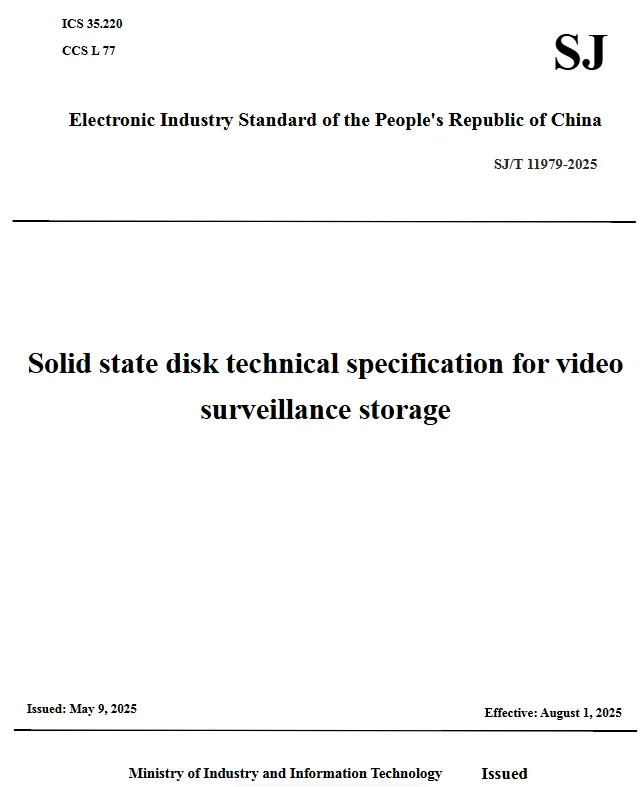
Solid state disk technical specification for video surveillance storage
Standard Details
SJ/T 11979-2025 (English Version)
- English translated version
- Sent to your email in 24h
SJ/T 11979-2025 (Chinese Version)
- Chinese original version
- Sent to your email in 12h
Standard Introduction
Drafted by CESI together with Hikvision Storage, Hikvision Digital Technology, Yangtze Memory, Inspur, and China Mobile, this standard went into effect in August 2025. Key performance requirements include a minimum MTBF of 1.5 million hours, SATA drives capped at 5W working power, and PCIe drives capped at 15W.
The document also mandates data retention of at least 8,760 hours for terminal-side recorders and 2,160 hours for central storage platforms—numbers that reflect the different operating temperatures and duty cycles of real-world surveillance deployments.
Standard Catalog
The standard consists of the following main sections:
1 Scope 1
2 Normative References 1
3 Terms and Definitions 1
4 General Principles 2
5 Technical Requirements 2
5.1 Appearance 2
5.2 Functions 2
5.2.1 Status Monitoring and Alarm 2
5.2.2 Data Interface 2
5.2.3 Operation and Maintenance Management 2
5.3 Performance 2
5.3.1 Storage Capacity 2
5.3.2 Power Consumption 3
5.3.3 Steady-state Performance 3
5.3.4 Maximum Response Time 3
5.3.5 Power-loss Data Protection 3
5.3.6 Error Rate 3
5.3.7 Total Bytes Written 4
5.4 Reliability 4
5.4.1 Data Retention Time 4
5.4.2 Mean Time Between Failures 4
5.5 Safety 4
5.5.1 Basic Requirements 4
5.5.2 Electrical Energy Source and Protection 5
5.5.3 Power Supply Adaptability 5
5.5.4 Data Security 5
5.5.5 Climatic Environment Adaptability 5
5.5.6 Mechanical Environment Adaptability 5
5.6 Electromagnetic Compatibility 5
6 Test Methods 5
6.1 Test Environment 6
6.2 Appearance 6
6.3 Functions 6
6.4 Performance 6
6.4.1 Storage Capacity 6
6.4.2 Power Consumption 6
6.4.3 Steady-state Performance 7
6.4.4 Maximum Response Time 8
6.4.5 Power-loss Data Protection 8
6.4.6 Error Rate 9
6.4.7 Total Bytes Written 9
6.5 Reliability 10
6.6 Safety 11
6.7 Electromagnetic Compatibility 14
7 Quality Assessment Procedures 14
7.1 General Rules 14
7.2 Inspection Classification 14
7.3 Type Inspection 15
7.4 Quality Conformance Inspection 15
8 Marking, Packaging, Transportation and Storage 16
8.1 Product Marking Requirements 16
8.2 Packaging Marking Requirements 16
8.3 Documents Included in Packaging 16
8.4 Transportation 16
8.5 Storage 16
English Version Preview
Preview coming soon. Need a sample? Contact us now.
Chinese Version Preview
Preview of the original Chinese version: