
GB 45671-2025 English PDF - Building Waterproof Coating Standard
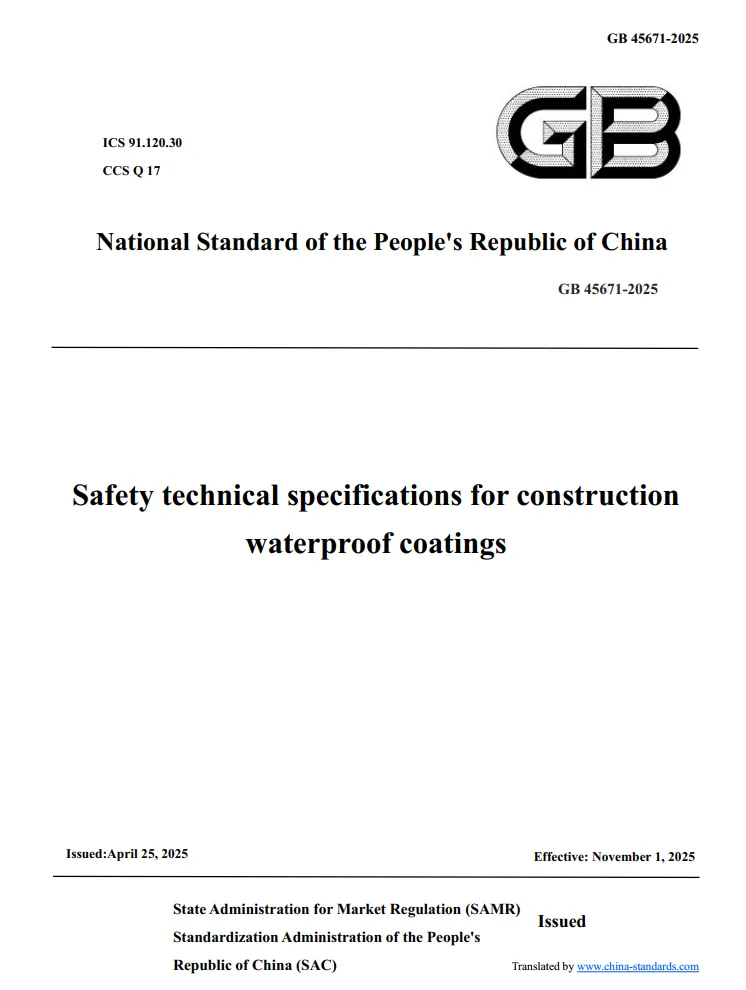
Safety technical specifications for construction waterproof coatings
Standard Details
GB 45671-2025 (English Version)
- English translated version
- Sent to your email in 24h
GB 45671-2025 (Chinese Version)
- Chinese original version
- Sent to your email in 12h
Standard Introduction
This document specifies the safety technical requirements for building waterproof coatings and describes the corresponding test methods.
This document is applicable to flexible waterproof coatings, cement-based waterproof materials, and other waterproof materials of liquid-type, two-component liquid-powder type and powder-type for construction engineering.
Standard Catalog
The standard consists of the following main sections:
Foreword
1 Scope
2 Normative References
3 Terms and Definitions
3.1 Flexible Waterproof Coating
3.2 Waterborne Waterproof Coating
3.3 Polymer Emulsion Waterproof Coating
3.4 Waterborne Polymer Asphalt Waterproof Coating
3.5 Reactive Polymer Waterproof Coating
3.6 Solvent-borne Waterproof Coating
3.7 Hot Melt Waterproof Coating
3.8 Cement-based Waterproof Material
4 Technical Requirements
4.1 Combustion Performance
4.2 Flash Point
4.3 Limit of Harmful Substances
4.3.1 Limits of Harmful Substances in Waterborne Waterproof Coatings
4.3.2 Limits of Harmful Substances in Reactive Polymer Waterproof Coatings
4.3.3 Limit of Harmful Substances in Solvent-borne Waterproof Coatings
4.3.4 Limit of Harmful Substances in Hot-melt Applied Waterproof Coatings
4.3.5 Limit of Harmful Substances in Powder-type Waterproof Materials
4.4 Material Engineering Requirements
4.4.1 Flexible Waterproof Coating Engineering Requirements
4.4.2 Cement-based Waterproof Material Engineering Requirements
5 Test Methods
5.1 Standard Test Conditions
5.2 Sample Preparation and Curing
5.2.1 Flexible Waterproof Coatings
5.2.2 Cement-based Waterproof Materials
5.3 Combustion Performance
5.4 Flash Point
5.5 Limit of Harmful Substances
5.5.1 Volatile Organic Compounds (VOC) Content
5.5.2 Formaldehyde Content
5.5.3 Ammonia Content
5.5.4 Benzene, Toluene, Ethylbenzene and Xylene Content
5.5.5 Phenol Content
5.5.6 Anthracene and Naphthalene Content
5.5.7 Free Diisocyanates (Free TDI) Content
5.5.8 Short-chain Chlorinated Paraffins (C₁₀~C₁₃) Content
5.5.9 Total Lead (Pb) Content
5.5.10 Content of Soluble Heavy Metals
5.6 Low-temperature Performance After Thermal Aging
5.7 Artificial Weathering Accelerated Aging
5.8 Water Resistance
5.8.1 Appearance
5.8.2 Retention Rate of Bond Strength with Base Layer After Immersion
5.9 Root Resistance Performance
5.9.1 Test Specimen Preparation
5.9.2 Planting Test
5.9.3 Test Completion and Recording
5.9.4 Test Report
5.10 Impermeability of Mortar Test Specimens
5.11 Bond Strength
5.11.1 Polymer Cement Waterproof Mortar
5.11.2 Polymer Cement Waterproof Slurry
5.12 Freeze-thaw Resistance
5.13 Water Absorption Rate
English Version Preview
Preview of the English translated version:
Chinese Version Preview
Preview of the original Chinese version: